Financial - Page 3

JGU establishes a new spintronics junior research group

The Johannes Gutenberg University Mainz (JGU), with funding from the German Research Foundation (DFG), is setting up an Emmy Noether independent junior research group to study spintronics.

Skyrmions generated by hairy balls image

Specifically, the TWIST (Topological Whirls in SpinTronics) work group will study skyrmions - magnetic "particles" or nodes within a magnetic texture. Skyrmions are more stable than other magnetic structures and react particularly readily to spin currents - which makes them interesting for spintronics applications.

Read the full story Posted: Oct 13,2016

£2.7 million granted for superconducting spintronics devices R&D

The UK's Engineering and Physical Sciences Research Council is funding a £2.7 million spintronics project led by the University of Cambridge. The aim of the project is to develop prototype superconducting spintronics devices for power-efficient supercomputing applications.

This work continues from the discovery of spin polarized supercurrents in 2010 at the University of Cambridge, as well as recent research that shows it is possible to power spintronic devices with a superconductor.

Read the full story Posted: Apr 17,2016

Singapore allocates $3.7 million to support Spintronics research projects

The Singapore's National Research Foundation (NRF) announced a new S$5 million ($3.7 million USD) fund to support Spintronics industry collaborations with research institutes in Singapore.

Last year the National University of Singapore together with Nanyang Technological University launched a new consortium (the Singapore Spintronics Consortium, or SG-SPIN), with an aim to encourage collaborative research partnerships between industry and the academia. The new $3.7 million fund will support existing and new SG-SPIN projects.

Read the full story Posted: Apr 23,2015

EU's Graphene Flagship is looking for a partner company for spintronics research

The Graphene Flagship announced a €350,000 work package that explores the potential of graphene spintronics for future devices and applications. The GF is searching for a new partner company to support device development and commercialisation of graphene spintronics, by applying it in specific device architectures dedicated to commercially viable applications and determining the required figures of merits.

The project's budget is for the period 1 April 2016 – 31 March 2018, and includes devices which require optimized (long distance) spin transport, spin-based sensors, and new integrated two-dimensional spin valve architectures. The Graphene Flagship expects that at the start of the Horizon 2020 phase (April 2016), spin injection and spin transport in graphene and related materials will have been characterised and the resulting functional properties will have been understood and modeled.

Read the full story Posted: Jan 28,2015

Young University of Alabama researcher granted $500,000 for spintronics research

The National Science Foundation (NSF) awarded a $500,000 CAREER Award grant for Dr. Claudia Mewes from the towards her spintronics research. The CAREER Award is the NSF’s most prestigious recognition of top-performing young scientists.

Dr. Claudia's research will combine different theories to close the gap between materials design and device performance with the ultimate goal of finding materials that work best in those environments. Dr. Claudia's research includes an educational outreach component looking to increase the number of young girls interested in pursuing careers in science.

Read the full story Posted: Jan 16,2015
The EU grants €9.7 million to a six-year Spintronics research project

The European Research Council (ERC) granted a six-year €9.7 million grant to professor Jairo Sinova from Johannes Gutenberg University Mainz (JGU) for its spintronics research. Professor Sinova will collaborate with researchers from the UK and the Czech Republic.

The project is titled "Spin-charge conversion and spin caloritronics at hybrid organic-inorganic interfaces". The researchers hopes that by combining principles of inorganic spintronics with organic materials (polymers) they will achieve better results than if they used purely inorganic systems. The advantages of using polymers include the flexibility of the material, control over the physical properties, and the fact that they are relatively easy to produce.

Read the full story Posted: Jan 23,2014

Two German universities collaborate on Spintronics commercialization research projects

Two German universities (Johannes Gutenberg University Mainz - JGU, and the University of Kaiserslautern) are collaborating on two Spintronics commercialization research projects (with a combined budget of €3.8 million).

The first project is the establishment of STeP (Spintronic Technology Platform) in Rhineland-Palatinate, which is designed to boost magnetic coating systems R&D. The main focus of the STeP research is into Heusler materials. This new collaboration means that academic research is being immediately transferred onto an industrial production line.

Read the full story Posted: Feb 07,2013

C-SPIN funds a five-year $958,000 magnetic research program at the University of Iowa

University of Iowa's researcher Michael Flatté has received a five-year, $958,000 contract from C-SPIN to study new Spintronics materials, with an aim to understand the internal dynamics of a magnet, and how magnetic waves within that magnet can be used to carry information quickly and efficiently around a computer chip.

His previous Spintronics research focused on theories of the fundamental magnetic properties of materials and the behavior of electric currents within them, as well as how to use these materials to construct nanoscale electronic circuits that require considerably less power to function.

Read the full story Posted: Feb 05,2013

SRC and DARPA grant $28 million to open a new Spintronics research center

The Semiconductor Research Corporation, and the Defense Advanced Research Projects Agency (DARPA) has awarded a $28 million five-year grant to open the Center for Spintronic Materials, Interfaces, and Novel Architectures, or C-SPIN. This is a multi-university and industry research center that aims to develop technologies for spin-based computing and memory systems. C-SPIN's research areas include perpendicular magnetic materials, spin channel materials (including topological insulators, monolayer MoS2 and graphene), spintronic interface engineering, spin devices and interconnects and spintronic circuits and architectures.

University partners include the University of Minnesota-Twin Cities, Carnegie Mellon University, Cornell University, MIT, Johns Hopkins University and the University of California, Riverside. Industry partners include IBM, Applied materials, Intel, Texas Instruments and Micron.

Read the full story Posted: Jan 18,2013

Buckyballs for Spintronics research granted €1.5 million from the ERC

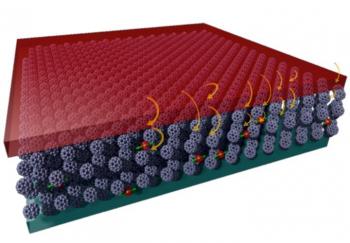
Researcher Michel de Jong of the NanoElectronics group (MESA+) in the University of Twente (Netherlands) received a €1.5 million grant from the European Research Council to fund his Spintronics work (this is his second ERC grant). Michel de Jong is focusing on organic materials, in particular in Buckyballs (spherical C60 molecules held together by weak bonds) sandwiched between two magnetic materials.

Michel explains that these molecules have very little effect on electron spin, which is a great advantage as it enables them to store spin information for much longer periods of time than silicon. Buckyballs have also been used to create Graphene Quantum Dots.

Read the full story Posted: Jan 22,2012